
Degrees of Freedom Explained: How to Read Dexterous Hand Specs
Source: https://sourcebotics.com/guides/degrees-of-freedom-dexterous-hands-explained/
TL;DRRead active versus total DOF, pressure sensors versus sensing units, and configuration-specific control interfaces before comparing robotic hands.
Document examples reviewed: 2026-09-15 · General selection guidance; no independent hardware testing
Separate joints, actuators and independent motion
In a mechanical description, degrees of freedom refers to independent ways a mechanism can move. In product descriptions, the term may also be used for a total joint count. Do not assume that every listed joint is independently commanded.
- A moving joint is an articulation in the mechanism. Its motion may depend on another joint.
- An actuator provides a controlled input. Linkages or tendons can connect an actuator to several joints.
- A coupled motion follows a mechanical relationship rather than an independent command.
- A passive motion can respond to external forces or compliance without its own commanded actuator.
Counting motors is a useful starting point, but still does not define the complete control behavior. Ask which commands are exposed, how they map to joint movement, and which movements are coupled. Neither a larger joint count nor a smaller control space establishes reliability or grasp success by itself.
Read three real model descriptions
| Model | What the reviewed reference distinguishes | Purchasing implication |
|---|---|---|
| Inspire RH56DFTP | Six controlled motions and 12 moving joints | Do not plan to command all 12 joints independently |
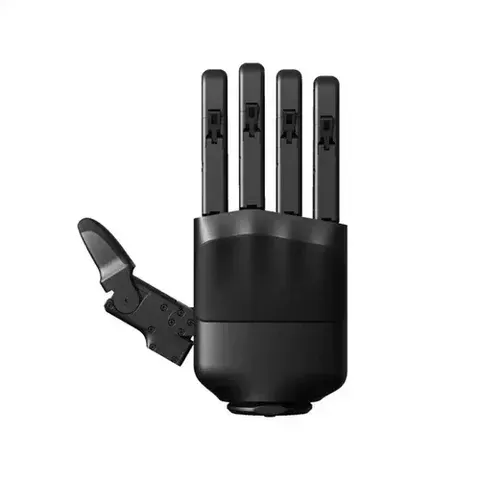
| Unitree Dex5-1 family | 20 total joints with 16 active | Ask for the joint map and the exact standard or P sensing variant |
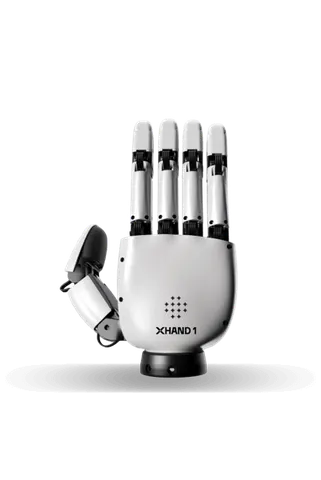
| Robotera XHAND1 | Original brochure specifies 12 active motions | Confirm the original model rather than transferring the number to Lite or Pro |
These examples are drawn from the RH56DFTP manual, Unitree Dex5 table and original XHAND1 brochure, reviewed on 2026-09-15. Their conventions should remain attached to the model, not converted into a universal ranking.
Sensing does not follow from the DOF count
Unitree's table assigns the 94 pressure-sensor total to Dex5-1P, not the non-P column. RH56DFTP's 5–17 tactile-sensor packages are not a comparable taxel total. Keep the option code and the definition of the count alongside any number.
Request a sensor map, data format, units, calibration procedure and timing information. Confirm what the application can read: raw measurements, processed contact information or only a status value. More sensing elements do not automatically provide the information your experiment needs.
Similarly, fingertip force, whole-hand grasp force and a static hanging load describe different measurements. Request the test pose and object conditions before treating any of them as a usable payload. Repeatability needs a test definition too; it does not establish absolute accuracy on an assembled arm-hand system.
Let the required movement decide
| Required behavior | Evidence to request |
|---|---|
| Grip a known object | Its dimensions, grasp pose, contact points and repeatable test results |
| Move a fingertip independently | The joint-command mapping and any mechanical coupling |
| Reorient an object inside the hand | Required motions demonstrated without undisclosed external support |
| Collect tactile learning data | Accessible observations synchronized with commands |
| Follow a teleoperation device | Mapping, limits and a sample action/observation recording |
There is no reliable universal threshold such as “six active axes is enough for every grasp” or “twelve axes makes it a research hand.” Geometry, control, sensing and the object matter together. Use the hand buyer's guide and comparison table to build a shortlist, then request the experiment-specific evidence.
The interface is part of that assessment. A bus name alone does not establish usable command rate or feedback latency. Confirm the protocol, driver, firmware and operating conditions for the quoted variant. The procurement checklist helps record those requirements; the price guide keeps the full configuration in the budget.
Sources and review scope
The linked manufacturer documents support the specific model examples. Other sections explain how to interpret a specification and prepare questions; they are not independent measurements or verified compatibility claims. Current prices and availability require a configuration-specific quotation.
FAQ
Is total DOF the same as motor count?
Not necessarily. Product descriptions may include joints that are mechanically coupled or passive. Request the manufacturer's joint and actuator map.
Is an underactuated hand worse?
Its motions are constrained differently. Evaluate whether those motions and the available feedback meet the task; the label does not establish a quality or reliability ranking.
Does a tactile count tell me the sensor resolution?
No. First establish whether the number means modules, sensing elements or another quantity, and inspect the output data and calibration details.
Planning a robotics purchase? Share the quantity, configuration and destination so we can check fit, availability and quote requirements.
Request a quote— The Sourcebotics sourcing desk
Products to investigate
- Controlled DOF
- 6
- Moving joints
- 12
- Fingertip repeatability
- ±0.2 mm
- Degrees of freedom
- 20 total; 16 active
- Hand mass
- 1100 g
- Fingertip force
- 10 N
- Active degrees of freedom
- 12; independently driven
- Weight
- 1.1 kg
- Dimensions
- 190.36 × 94 × 47 mm