
Choosing a Chinese Quadruped Robot in 2026: Research and Inspection Shortlists
Source: https://sourcebotics.com/guides/best-quadruped-robots-from-china-2026/
TL;DRBuild a research or inspection shortlist around edition-specific control access, payload integration, route acceptance and comparable quote scope.
Start with the work
| Task | First selection question | Evidence to request |
|---|---|---|
| Demonstrations | Do the supplied functions cover the demonstration? | Edition-specific function list and a representative demonstration |
| Locomotion research | Can the buyer use the required control and state interfaces? | SDK documentation, firmware compatibility and a working example |
| Mobile perception | Can the payload fit, communicate and receive power? | Mounting dimensions, connection pinouts and a complete mass/power budget |
| Industrial inspection | Can the system complete the specified route and collect usable data? | Loaded mission test, sensor output, operating limits and support scope |
Write an acceptance result before picking a model: for example, collecting synchronized sensor data over your route with the complete payload. Evaluate the robot against that result rather than requiring every advertised maximum simultaneously.
Four candidates and their configuration boundaries
| Candidate | Relevant documentary distinction | Before requesting a quote |
|---|---|---|
| Unitree Go2 EDU | EDU development support differs from Air/Pro; X is partial | Name the edition and required commands |
| DEEP Robotics Lite3 | Four editions have different equipment and walking-load allowances | Identify Basic, Venture, Pro or LIDAR |
| Unitree B2, legged | Legged B2 and wheel-legged B2-W are separate configurations | Scope the route, payload and chassis |
| DEEP Robotics X30 | X30 and X30 Pro expose different connection options | List sensor, power and data requirements |
The configuration distinctions above are documented in the Go2 edition table, Lite3 table, B2 specifications and X30/X30 Pro table. They do not establish interchangeable software, equivalent payloads or a finished autonomous inspection solution.
The full quadruped catalog includes additional platforms. Models outside this shortlist require their own configuration review; absence here is not a claim that they are unsuitable or unavailable.
Research: check the complete software path
Request the hardware edition, SDK release, firmware, host operating system and required interfaces together. Ask the supplier to demonstrate the same command and state-data path that your experiment will use. Obtain a list of dependencies and any permissions or licences before ordering.
Record which parts of the proposed setup are delivered by the manufacturer, provided by an integrator or assembled by your team. Budget integration time separately. A public repository can help assess the software work, but it is not a contractual promise of support for every hardware revision.
Inspection: test with the actual payload
The route matters: surface transitions, stairs, clearances, communications and charging locations. Describe those alongside the sensor kit and its mounting position. Ask for an acceptance run with that equipment installed and preserve the test conditions in the order.
Read load, speed and endurance as separate claims until a test joins them. Check the robot and payload's operating limits individually. An IP claim for the chassis does not establish the protection of a custom connector or sensor installation. Missing protection information must remain unknown.
For wheel-legged candidates, evaluate where rolling helps on the proposed route and where transitions are required. Request equivalent task output from each candidate instead of treating a higher maximum speed as automatically more useful.
Compare the offers
Use one specification and one quote worksheet for every supplier. Include hardware, development access, sensors, batteries, commissioning, training, spares, delivery and support. Record exclusions and unresolved questions alongside each offer.
The quadruped price guide separates public manufacturer prices from configuration-specific quotations. The procurement checklist provides a reusable worksheet. When ready, submit the task and configuration through the RFQ form.
Sources and corrections
Manufacturer pages reviewed September 15, 2026 (Asia/Shanghai): Unitree Go2, DEEP Robotics Lite3, Unitree B2 and DEEP Robotics X30/X30 Pro. These pages do not state revision dates.
This revision removes unsupported market-share, shipment and deployment totals; unsubstantiated brand-wide price comparisons; and a table that mixed variants, load conditions and protection ratings. It is a documentary selection guide, not an exhaustive market census or a hardware evaluation.
FAQ
Which model is best for a research lab?
The one that provides the interfaces, documentation, payload provision and support required by the planned experiments. Start with those requirements and obtain an edition-specific offer.
Can I compare industrial robots by their starting price?
Only after establishing equivalent hardware, software, integration and support scope. This review does not substantiate a fixed price advantage between brands.
Does a demonstration prove autonomous operation on my site?
It demonstrates the conditions shown. Ask how the robot was controlled, what infrastructure it used and what happens when communication or localization fails, then test your route.
Planning a robotics purchase? Share the quantity, configuration and destination so we can check fit, availability and quote requirements.
Request a quote— The Sourcebotics sourcing desk
Products to investigate
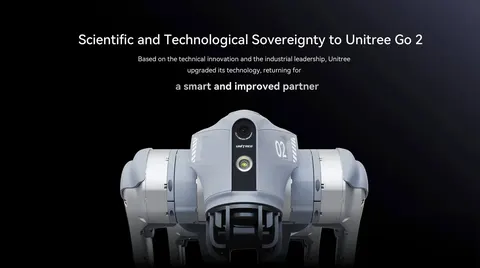
- Weight (with battery)
- About 15 kg
- Nominal payload
- About 8 kg
- Development access
- Secondary development supported on EDU; confirm low-level access and software version in the quotation
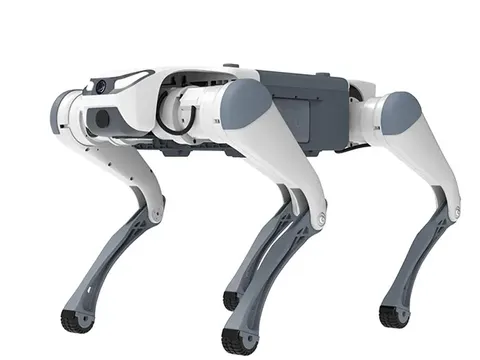
- Dimensions
- 610 x 370 x 406-496 mm (standing)
- Weight
- 12-13.5 kg (with battery)
- DoF
- 12
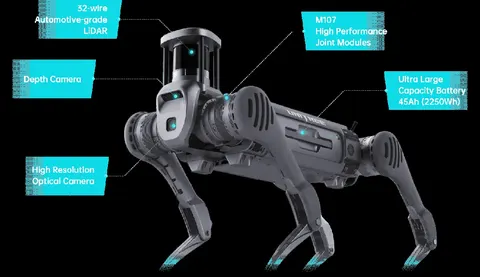
- Weight (with battery)
- About 60 kg
- Ingress protection
- IP67
- Walking load
- Over 40 kg
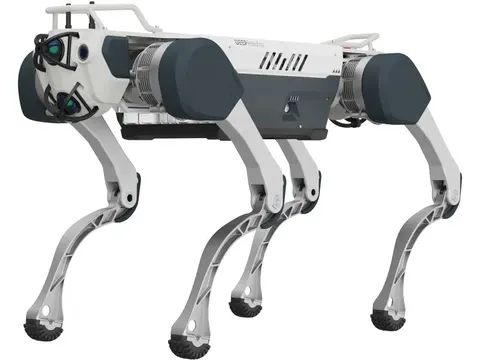
- Weight
- 56 kg
- Standing dimensions
- 1,000 × 695 × 470 mm
- Maximum speed
- ≥4 m/s, manufacturer test conditions