Chinese Dexterous Hands: A Research Buyer's Guide & Comparison
Source: https://sourcebotics.com/guides/chinese-dexterous-hands-2026-buyers-guide/
TL;DRSelect a dexterous hand by the motions and data your experiment requires. Compare active control axes, fingertip geometry, sensing options, communication interfaces and the complete integration package. Inspire RH56DFTP, Unitree Dex5-1 and Robotera XHAND1 represent different choices; their joint counts, force figures and tactile packages are not interchangeable. Use a configuration-specific quote before choosing on price.
Choose the task before the hand
A known-object grasp, a contact-learning experiment and in-hand reorientation need different hardware. More joints can expand the available movements, but cannot replace a suitable finger geometry, stable control or useful sensor data.
| Your task | Prioritize | Ask the supplier to demonstrate |
|---|---|---|
| Repeat a known grasp | Object clearance, contact surfaces, repeatability and required force | Your object, grasp pose and cycle with failures disclosed |
| Learn from touch | Accessible raw data, calibration, timing and the exact tactile option | A sample recording with units, timestamps and sensor map |
| Reorient objects inside the hand | Independently controlled motions and thumb workspace | Required motions without external support or hidden resets |
| Collect human demonstrations | Teleoperation mapping, logging and mechanical limits | The data path from input device to robot actions and observations |
| Mount on an existing arm | Wrist drawing, payload allowance, cabling and interface support | The complete mounted arrangement with your controller |
For side-by-side specifications, open the dexterous-hand comparison. The table is a shortlist tool; compatibility still needs the selected hardware and firmware revisions.
Three documented options and their limits
| Model | Documented distinction | Why investigate it | What to establish before purchase |
|---|---|---|---|
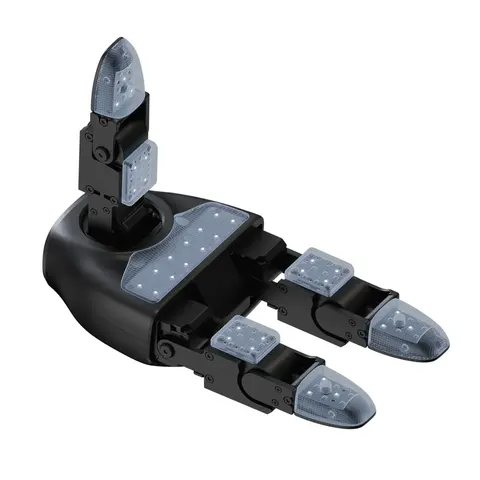
| Inspire RH56DFTP | Six controlled motions, 12 moving joints; tactile package varies | A smaller control space with documented registers and contact sensing | Left/right hand, tactile coverage and exact communication configuration |
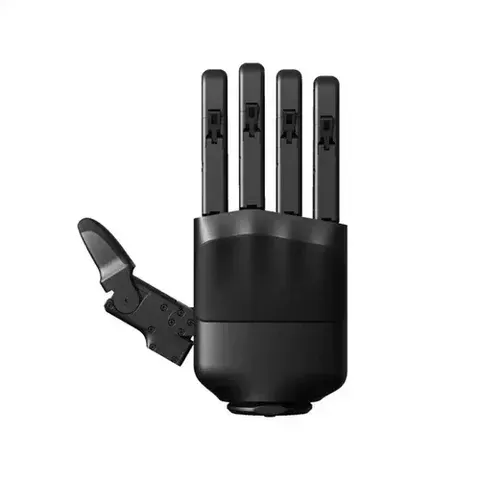
| Unitree Dex5-1 family | 20 total joints including 16 active; USB 2.0; separate Dex5-1 and Dex5-1P variants | More independently controlled motion for manipulation development | Whether the quote is for Dex5-1P when pressure-array data is required |
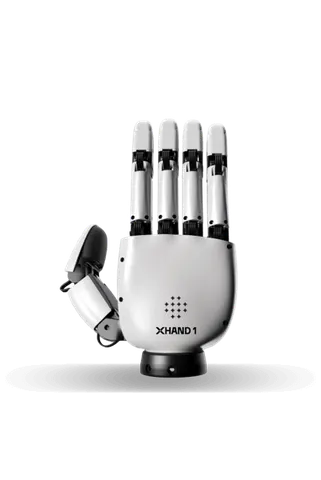
| Robotera XHAND1 | Original XHAND1 brochure describes 12 active motions and optional fingertip tactile sensing | A separately driven hand to evaluate for in-hand manipulation | Original XHAND1 versus Lite/Pro, sensor option and supplied software |
The RH56DFTP V1.0.0 manual lists Modbus TCP with either CAN 2.0 or RS-485. Its 5–17 tactile sensors are configuration-dependent sensor packages, not a universal taxel count. Do not turn a family description into a promise that every interface and sensor is included.
The Unitree specification table puts the 94 pressure-sensor total under Dex5-1P. The non-P column does not list that array. This matters more than a broad listing that simply says “Dex5 with tactile.”
The original XHAND1 brochure is specific to that model. Robotera now lists several hand variants on its official product site; do not transfer specifications between them.
Read force and sensing numbers carefully
A fingertip pushing force, a whole-hand grasp force and a static hanging load describe different tests. None alone tells you whether the hand can hold your object while the arm accelerates. Record the object shape, friction, hand orientation, duration and motion alongside the claimed load.
The RH56DFTP manual labels its 30 N figure as five-finger grip. Do not restate it as a 3 kg per-fingertip payload. Inspire's explanation of hand metrics also distinguishes active finger output from passive load capacity.
For sensing, request the actual data structure. A sensor module can contain multiple sensing elements; a count alone does not establish spatial resolution, force accuracy or usable update rate. Check whether your application receives raw measurements, processed contact events or only a grip-status flag.
Integration is four separate checks
Mechanical: obtain a dimensioned wrist drawing, connector clearance, hand mass and the tool center of gravity. Confirm the arm's payload and moment limits for the mounted assembly.
Electrical: match voltage, peak current, connector pinout, cable length and the required interface adapter. An Ethernet connector does not mean EtherCAT; CAN and CAN FD are not interchangeable labels.
Software: request the exact SDK or protocol document, supported operating system, firmware revision, example application and hand model. A ROS package should name the supported distribution. An available driver is evidence to inspect, not proof that it builds with your setup.
Experiment: define the object set, grasping motion, acceptable failures and evidence to record. Use a supplier-agreed test plan; a marketing demonstration is not a repeatability test for your task.
Put the complete configuration on the quote
List one hand or a left/right pair explicitly. Then list tactile options, wrist adapter, cables, interface board, power supply, software scope and any integration work. Request separate prices and availability for replacement fingers, pads and other service parts relevant to the model.
For a G1 project, compare the actual G1 EDU hand configurations before ordering a standalone hand. Sharing a manufacturer or a communication bus does not establish a supported retrofit.
The hand price guide explains how to normalize quotes. Use the procurement checklist to record evidence and unresolved questions, then request a hand configuration review.
Sources and review scope
The linked Inspire manual and metric explanation, Unitree model table, and Robotera brochure and product site were reviewed on 2026-09-15. The comparison uses their documented configuration distinctions. Selection questions are Sourcebotics editorial guidance; no independent durability, grasp-success or compatibility testing is claimed.
FAQ
Is six active motions enough?
It can be enough for a defined grasp, depending on finger geometry and control. Request the required grasp demonstration; do not infer success from a joint count.
Does tactile sensing come standard?
It depends on the full model and option. For example, Unitree's table distinguishes Dex5-1 from Dex5-1P, and RH56DFTP tactile coverage varies.
Can I use the hand with ROS 2?
Ask for a driver, supported distribution and reproducible example for the exact hardware and firmware. Protocol access alone does not establish a maintained ROS 2 integration.
Which is the most reliable hand?
This document review does not establish a reliability ranking. Request test conditions, maintenance requirements, spare-part availability and contractual service terms.
Planning a robotics purchase? Share the quantity, configuration and destination so we can check fit, availability and quote requirements.
Request a quote— The Sourcebotics sourcing desk
Products to investigate
- Controlled DOF
- 6
- Moving joints
- 12
- Fingertip repeatability
- ±0.2 mm
- Degrees of freedom
- 20 total; 16 active
- Hand mass
- 1100 g
- Fingertip force
- 10 N
- Active degrees of freedom
- 12; independently driven
- Weight
- 1.1 kg
- Dimensions
- 190.36 × 94 × 47 mm