
Slip Rings vs Contactless Rotary Transmission for Robots
Source: https://sourcebotics.com/guides/slip-rings-vs-wireless-rotary-transmission/
Short answerA slip ring passes power and signals across a rotating joint through sliding contacts; contactless rotary joints use inductive coupling, radio or light instead. Slip rings are compact and carry both power and data at low cost. Contactless designs avoid contact wear and suit very high speeds or long service intervals. Choose by circuits, current, data rate, speed, lifetime and space.
Why a rotating joint needs special wiring
A joint that turns continuously, or more than a turn or two, cannot use an ordinary cable without twisting it to failure. Pan-tilt heads, LiDAR heads, turntables, wrist rotation, mobile robot steering modules and rotating sensor masts all need a way to pass power and signals across the rotation. The two main approaches are sliding contact and contactless transmission.
How a slip ring works
A slip ring has conductive rings on the rotor and brushes on the stator that press against them. Each ring and brush pair forms one circuit. Brushes may be precious-metal wires, gold-on-gold contacts for low-noise signals, or fibre-bundle brushes made of many fine wires that share the contact and wear slowly. Power circuits use wider rings and larger brushes for higher current.
Capsule slip rings are compact cylinders for small devices. Through-bore slip rings have a hollow centre for a shaft, hydraulic line or fibre. Pancake slip rings arrange the rings on a flat disc where axial space is short.
Data through slip rings
Analog signals, CAN, RS-485 and encoder lines pass through standard signal rings. Ethernet needs rings and brushes designed to preserve signal integrity, and manufacturers specify which Ethernet speeds a model supports. High-speed video and Gigabit Ethernet may need specialised contacts or a contactless channel. Always ask for the supported protocols and the test conditions.
Contactless alternatives
Inductive power transfer. A rotary transformer couples power across an air gap between two coils. There is no contact wear, but efficiency, size and cost increase with power.
Contactless data links. Near-field radio or capacitive couplers pass data across a short gap and can carry Ethernet without contacts.
Fibre-optic rotary joints. Pass optical signals across rotation, useful for very high data rates or electrically noisy environments.
Contactless modules are often combined with a slip ring: power through rings, high-speed data through a contactless channel.
| Approach | Power | Data | Wear | Typical use |
|---|---|---|---|---|
| Slip ring, signal contacts | Low | Analog, CAN, RS-485, encoder | Brushes wear over time | Pan-tilt heads, small turntables |
| Slip ring with Ethernet-rated rings | Low to moderate | Ethernet at specified speed | Brushes wear over time | Robot wrists, sensor heads |
| Slip ring, power rings | High | With separate signal rings | Brushes wear over time | Turntables, steering modules |
| Inductive power transfer | Moderate | Needs separate channel | No contact wear | High-speed or sealed joints |
| Contactless data coupler | None | High-speed data | No contact wear | Ethernet across rotation |
| Fibre-optic rotary joint | None | Very high data rates | Low | Video, high-bandwidth sensors |
Specifications to compare
Circuits and current. List every circuit you need, its current and voltage, and add spares. Power circuits often need several rings in parallel.
Data. State each protocol and speed. For Ethernet, confirm the supported standard and the cable lengths on either side.
Speed. Maximum rotational speed affects brush wear and heat. Very high speeds favour contactless designs.
Lifetime. Slip-ring life is usually stated in millions of revolutions under defined conditions. Compare at your speed and duty cycle.
Electrical noise. Contact resistance variation creates electrical noise. Low-noise contacts matter for analog sensor signals.
Environment. Check IP rating, operating temperature, and resistance to vibration, especially on mobile robots.
Mechanics. Bore size, outer diameter, length, mounting flange, anti-rotation tab and wire lengths on each side.
Integration tips
Mount the slip ring so that the rotor is driven by the rotating part without carrying radial load; use the anti-rotation tab or a flexible coupling rather than the wires. Route power and signal wires separately on both sides. Shield sensitive signals and keep their return paths in the same slip ring. Leave access for inspection or replacement.
Checklist for a slip ring inquiry
- Number of circuits, with current and voltage for each.
- Data protocols and speeds.
- Maximum and continuous rotational speed.
- Required lifetime and duty cycle.
- Dimensions: bore, outer diameter, length and mounting.
- Environment: IP rating, temperature, vibration.
- Wire lengths, connectors and labelling on each side.
Sources
FAQ
Can I run Ethernet through any slip ring?
No. Ethernet needs rings designed and tested for it. Ask for the supported speed and the test conditions.
How often do slip rings need maintenance?
It depends on the design, speed and environment. Many sealed slip rings are maintenance-free for their rated life; ask the supplier for the expected service interval.
When is a contactless joint worth the extra cost?
When rotation speed is high, the joint runs continuously, maintenance access is difficult, or very high data rates are required.
Planning a robotics purchase? Share the quantity, configuration and destination so we can check fit, availability and quote requirements.
Request a quote— The Sourcebotics sourcing desk
Related products
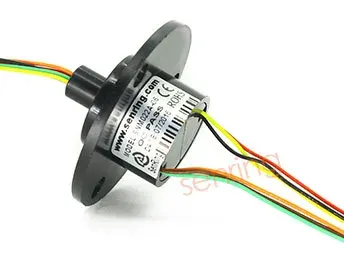
- Material
- Gold-to-gold precious metal contacts; engineered plastic housing
- Process
- Precision assembly with 150 mm standard lead wires
- Key Dimension
- OD 22 mm; length 19-54.5 mm
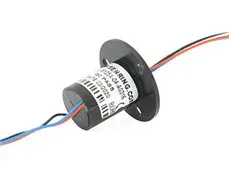
- Material
- Gold-to-gold precious metal contacts; engineered plastic housing
- Process
- Precision assembly with flying leads
- Key Dimension
- OD 12.5 mm
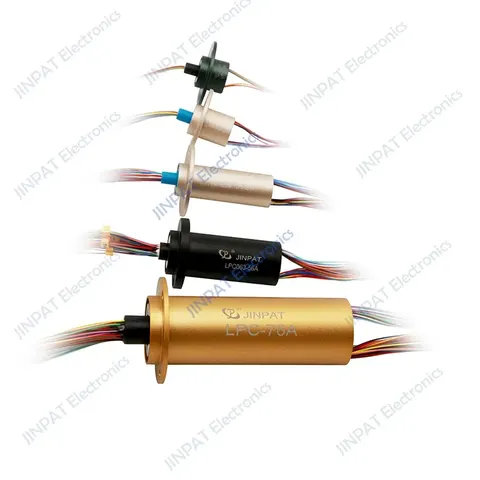
- Material
- Gold-plated precious metal contacts; engineered plastic housing
- Process
- Precision capsule assembly with flying leads
- Key Dimension
- OD 12.5-16 mm
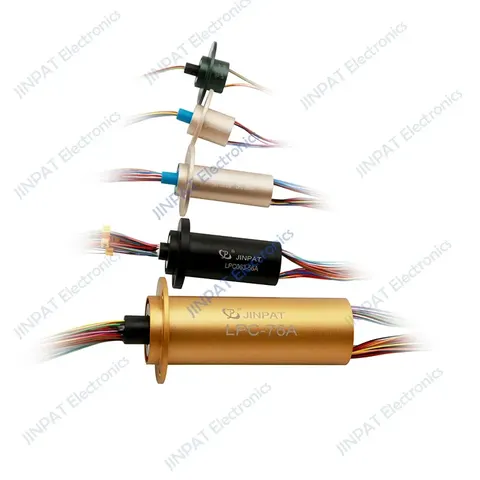
- Material
- Gold-plated precious metal contacts
- Key Dimension
- OD 5.5-11.1 mm
- Load/Current Rating
- 2A or more per circuit; up to 12 circuits; 240 VAC/DC