
Structured Light vs Stereo vs Time-of-Flight Cameras for Robots
Source: https://sourcebotics.com/guides/structured-light-vs-stereo-vs-tof-cameras/
Short answerStereo cameras measure depth by matching two images, structured-light cameras by observing a projected pattern, and time-of-flight cameras by timing modulated light. Stereo suits outdoor and mobile robots, structured light suits precise close-range picking and inspection, and time-of-flight suits compact indoor sensing. Compare cameras at the working distance you need, in your lighting, on your surfaces.
Three ways to measure depth
A 3D camera produces a depth image: for each pixel, the distance to the surface. The three common principles differ in how they get that distance, and the differences show up as accuracy, range, frame rate and behaviour on difficult surfaces.
Stereo vision
A stereo camera has two image sensors a fixed distance apart, the baseline. The same point appears at slightly different positions in the two images; the difference, called disparity, gives the distance by triangulation. Passive stereo relies on texture in the scene and struggles on plain walls. Active stereo adds an infrared projector that paints a random dot pattern onto surfaces, giving texture to match even on plain surfaces, and still works in sunlight where the scene's own texture takes over.
Depth error in stereo grows roughly with the square of the distance, so accuracy is best near the camera. A wider baseline improves accuracy at longer range but increases the minimum distance.
Structured light
A structured-light camera projects a known pattern, such as stripes or coded patterns, and observes how it deforms on the surface with a camera offset from the projector. Industrial units project a sequence of patterns and combine them to reach very fine depth resolution, often at the scale of fractions of a millimetre at short distances. The trade-off is that the scene must stay still during the sequence, and strong ambient light can wash out the pattern.
Structured-light cameras are widely used for bin picking, depalletising, inspection and measurement, where accuracy at a fixed working distance matters more than frame rate.
Time of flight
A time-of-flight (ToF) camera illuminates the scene with modulated infrared light and measures, for every pixel, how long the light takes to return. Indirect ToF (iToF) measures the phase shift of continuously modulated light; direct ToF (dToF) times individual pulses. ToF cameras are compact, produce depth for every pixel at video rates and need no texture, which makes them common in indoor mobile robots and people-sensing.
ToF accuracy is affected by multipath, where light bounces between surfaces before returning, and by very dark or highly reflective materials. Range and accuracy also drop in strong sunlight.
| Principle | How depth is measured | Strengths | Limitations | Typical robot use |
|---|---|---|---|---|
| Passive stereo | Disparity between two images | Works outdoors, no emitter | Needs scene texture | Outdoor navigation |
| Active stereo | Disparity with projected IR texture | Indoor and outdoor, wide range | Error grows with distance | Mobile robots, manipulation |
| Structured light | Deformation of projected patterns | High accuracy at close range | Scene must be still, ambient light | Bin picking, inspection |
| Indirect ToF | Phase of modulated light | Compact, dense, fast | Multipath, sunlight | Indoor navigation, people sensing |
| Direct ToF | Timing of light pulses | Longer range than iToF | Lower resolution in many designs | Obstacle detection |
Specifications to compare
Working range and accuracy. Accuracy is meaningful only at a stated distance and target. Compare cameras at your working distance, and ask how accuracy is defined: absolute error, plane-fit noise or repeatability.
Resolution and field of view. A wide field of view spreads the same pixels over a larger area, so each pixel covers more surface. Calculate the size of one pixel on your object at your distance.
Frame rate and exposure. Moving robots and moving objects need short exposures and high frame rates. Multi-pattern structured light usually needs the scene to stay still.
Ambient light. Check the specified performance under sunlight or factory lighting if your robot works outdoors or near windows.
Surfaces. Shiny metal, black plastic and transparent objects are difficult for all principles. Test with your actual parts.
Interface and software. USB and Ethernet versions differ in cable length and synchronisation. Check the SDK, operating system support and ROS drivers, and whether colour and depth are aligned in hardware.
Choosing for your application
For a mobile robot that moves indoors and outdoors, active stereo is a common choice. For a fixed cell picking parts from bins, structured light usually gives the accuracy needed. For compact indoor robots that need dense depth close by, ToF is efficient. Many robots combine principles: a stereo camera for navigation and a structured-light camera at the gripper.
Sources
FAQ
Why does my depth image have holes?
Holes appear where the camera cannot match images, cannot see the pattern, or gets no valid return: shadows behind objects, shiny or dark surfaces and edges. Changing the viewing angle, exposure or camera type often helps.
Can several 3D cameras work side by side?
Active cameras can interfere with each other. Many models support hardware synchronisation or interference reduction; check this if you plan to mount several cameras.
Do I need calibration?
Cameras are calibrated at the factory. You still need hand-eye calibration to relate the camera to your robot's coordinate system.
Planning a robotics purchase? Share the quantity, configuration and destination so we can check fit, availability and quote requirements.
Request a quote— The Sourcebotics sourcing desk
Related products
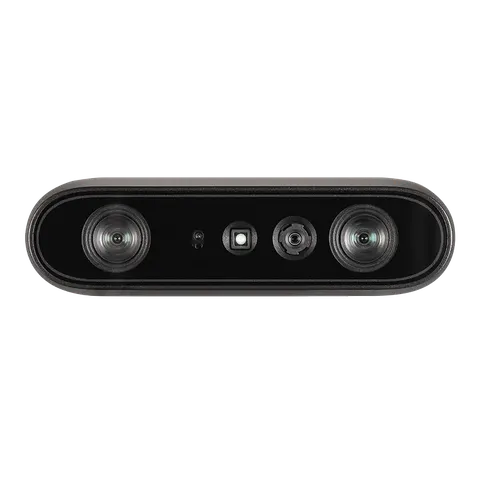
- Technology
- Active and passive stereo IR
- Depth Range
- 0.10-20 m+ (optimal 0.26-3 m)
- Depth Accuracy
- <1.5% @2 m
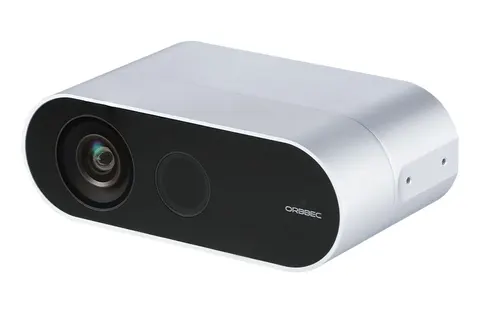
- Technology
- Time of Flight (850 nm)
- Depth Range
- 0.25-5.46 m (mode dependent)
- Depth Accuracy
- <11 mm + 0.1% of distance; random error <=17 mm
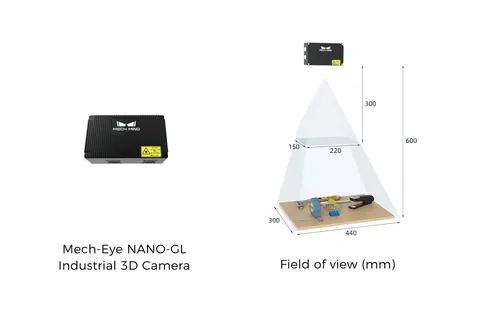
- Technology
- Structured light (LED)
- Depth Range
- 300-600 mm
- Depth Accuracy
- 0.1 mm @0.5 m
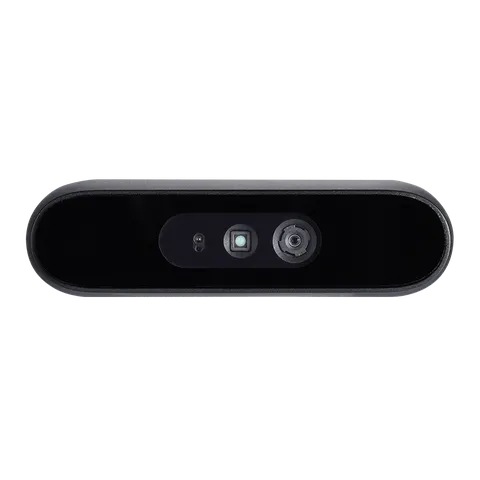
- Depth filter
- IR-Pass
- Optimal depth range
- 0.26–3 m
- Depth resolution
- Up to 1280 × 800 at 30 fps