- Type
- 128-channel hybrid solid-state LiDAR
- Typical range
- 210 m at 10% reflectivity; confirm variant/test conditions
- Field of view
- 120° x 25.4°
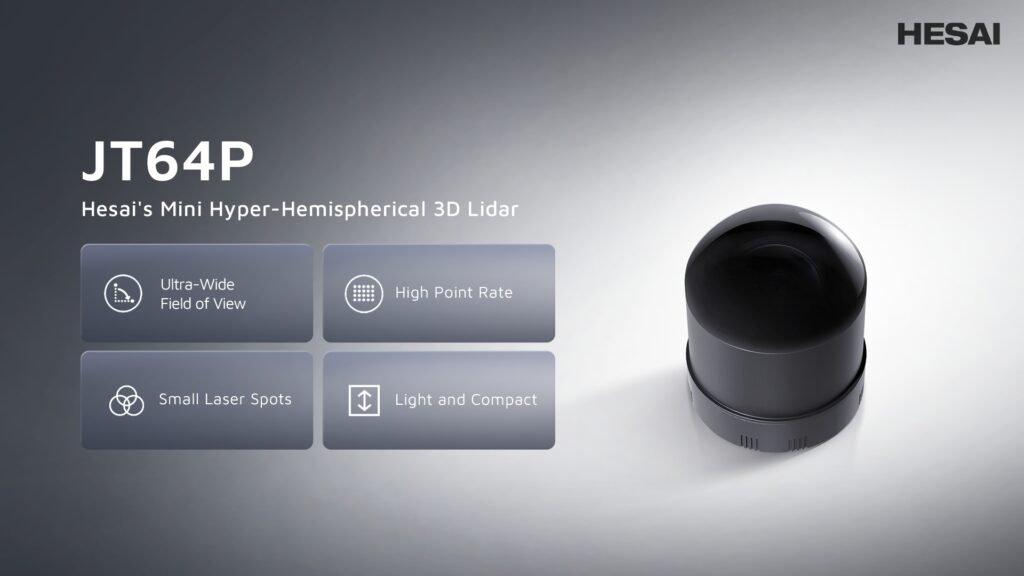
Hesai JT64P 64-Channel Mechanical 3D LiDAR
JT64P is a compact 64-channel rotating LiDAR for spatial scanning. The July 2026 manual documents 20 m at 10% reflectivity and 499,500 valid points/s in single return. Match firmware, calibration and field-of-view definitions before selecting the delivered configuration.
Choosing this model
Read the product documentationSourcebotics selection notes, based on the published documentation.
Application fit
- Evaluating a compact 64-channel sensor for handheld or robot-mounted spatial digitization.
Integration planning
- J09-en-260720 applies from software 15.AF.B0.00.02.L, sensor firmware 2.b.0593 and controller firmware 1.b.0035. Match all three and the delivered hardware to the manual.
- Use 100Base-TX Ethernet, the documented 9–32 V supply and the correct connector/harness. The manual calls for an external supply capable of at least 2.6 A and 30 W; typical sensor consumption is lower.
- The official SDK 2.0 explicitly lists JT64P and publishes Modified BSD source. Check its dependencies and use the per-unit angle correction file; an SDK listing is not an integration acceptance test.
Selection considerations
- The 0–60 m instrumented interval is not a guarantee of detecting every target at 60 m. The 20 m at 10% figure is specified at normal incidence, 100 klx, detection probability above 70% and false-alarm rate below 1e-4.
- Keep field-of-view definitions separate: the product page advertises 360° × 189° hyper-hemispherical coverage, while the manual reports a 95° vertical projection (−4.4° to 88.7°). Confirm channel-angle geometry for the intended mounting; these labels are not interchangeable.
- The March 2026 launch quotes 1,152,000 points/s, 9.5 W, 250 g and relative precision below 1 cm. The later J09 manual instead specifies 499,500/999,000 valid points/s after zenith scan-rate reduction, 7.6 W, <265 g and 2 cm typical sensor precision. Match revision, return mode and metric; do not treat launch SLAM precision as sensor ranging accuracy.
- IP6K7 and Class 1 are manufacturer-reported component claims. No independent hardware test, certificate review, safety-system approval or shipment availability is asserted.
Technical specifications
Product documentation| Scanning method | 64-channel mechanical rotation; time of flightReference ↗ |
| Instrumented range | 0–60 m; distinct from conditional detection capabilityReference ↗ |
| Detection capability | 20 m at 10% reflectivity across all channels; normal incidence, 100 klx, PoD >70%, FAR <1e-4Reference ↗ |
| Accuracy / precision | ±3 cm typical mean ranging error / 2 cm typical standard deviation; varies with target, distance and temperatureReference ↗ |
| Horizontal / vertical field | 360° horizontal; 95° vertical projection (−4.4° to 88.7°), not the website’s 189° geometry labelReference ↗ |
| Angular resolution | Horizontal 0.4° at 10 Hz / 0.8° at 20 Hz; vertical 1.5° averageReference ↗ |
| Frame rate | 10 or 20 HzReference ↗ |
| Valid point rate | 499,500 points/s single return; 999,000 dual; includes zenith scan-rate reductionReference ↗ |
| Return modes | Single: first, strongest or last. Dual: last+strongest (default), last+first or first+strongestReference ↗ |
| Data interface | 100Base-TX Ethernet; point-cloud UDP packetsReference ↗ |
| Data rate | 22.82 Mbps single return / 45.65 Mbps dual returnReference ↗ |
| Supply | 9–32 V DC at connector; external supply capability at least 2.6 A, 30 WReference ↗ |
| Power consumption | 7.6 W typical at 25°C, 10 Hz; connection box/accessories excludedReference ↗ |
| Dimensions / mass | Ø62.55 mm base × 73.05 mm height; <265 gReference ↗ |
| Ambient operating temperature | −20°C to 65°CReference ↗ |
| Protection / laser class | IP6K7; 905 nm Class 1, manufacturer-reportedReference ↗ |
| Software reference | Hesai SDK 2.0 explicitly lists JT64P; Windows 10 and Ubuntu 16/18/20/22.04Reference ↗ |
Reference specifications for the listed model. Options, test conditions and integration requirements should be confirmed for your selected configuration.
Supplier
Hesai develops automotive and robotics LiDAR. The Shanghai operating company, Hesai Technology Co., Ltd., is separate from the listed holding company Hesai Group (Nasdaq HSAI; HKEX 2525). Select sensors by exact model, calibration files and integration requirements.
Downloads
Product documentation
Manufacturer and distributor references for model selection and technical review. Latest reference check: September 15, 2026.
Configuration & quotation
Specify the exact model or variant, required interfaces and accessories, quantity and delivery destination. Use the quotation to confirm the supplied configuration, current availability and commercial terms.
Ask for the current datasheet, delivery schedule, warranty scope and any documentation required for your destination. Use our procurement checklist to prepare the requirements, or download the worksheet.
Discuss this configurationFAQ
Can the launch point rate and 189-degree field be used directly in a comparison?
Keep the document, return mode and geometry definition attached. J09-260720 gives 499,500 single or 999,000 dual valid returns per second after zenith scan-rate reduction, and describes a 95-degree projected vertical field. The launch and website use different headline figures; their exact revision relationship remains unconfirmed.
Is the SDK open and is the sensor ready to ship?
The official SDK explicitly supports JT64P and publishes Hesai source under Modified BSD terms. Firmware, calibration, optional dependencies, accessories, stock, destination availability and Sourcebotics commercial terms still require confirmation. No sensor or SDK test was performed.
Related models
Considering Hesai JT64P 64-Channel Mechanical 3D LiDAR? Share the quantity, configuration and destination so we can check fit, availability and quote requirements.
Request a quote— The Sourcebotics sourcing desk