
AMRs and Mobile Robots from China: How to Choose for Warehouses and Factories
Source: https://sourcebotics.com/guides/mobile-robots-buyers-guide/
Short answerChoose the robot type from what has to move: racks, totes, cases or pallets. Then size the fleet from your order profile, not from a single robot's top speed. Check the navigation method against your building, the floor against the maker's stated conditions, and the fleet software against your warehouse systems. A quotation is complete only when it covers robots, chargers, software, integration and site deployment.
Start from the load and the flow
Mobile robots for logistics are built around one kind of load. Before comparing brands, describe what moves through your site:
- Unit load: rack, tote, carton, roll cage or pallet, with dimensions and the heaviest weight.
- Storage: floor stacks, shelving, racking and its height, or a mix.
- Flow: orders or moves per hour at the average and at the peak, and how many hours a day the system runs.
- Building: aisle widths, doors, ramps, lifts, the mezzanine or level changes, and areas shared with people or manual forklifts.
- Systems: the warehouse management system or MES the robots must take tasks from, and who owns that interface.
Most Chinese makers offer several robot families. With the list above they can propose a type and run a throughput simulation on your data.
Robot types and what they move
| Type | Load it moves | Example models on Sourcebotics | Figures from manufacturer documents |
|---|---|---|---|
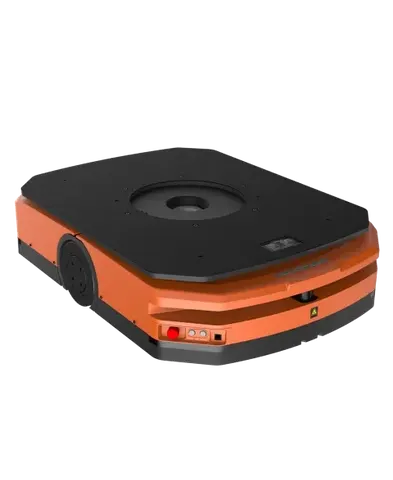
| Under-rack lifting robot | Mobile racks or shelves lifted from below and brought to a pick station | Quicktron H80, Quicktron M100, Quicktron M150 | Rated loads of 800, 1,000 and 1,500 kg, QR code navigation, 1.5 m/s maximum no-load speed (Quicktron M series) |
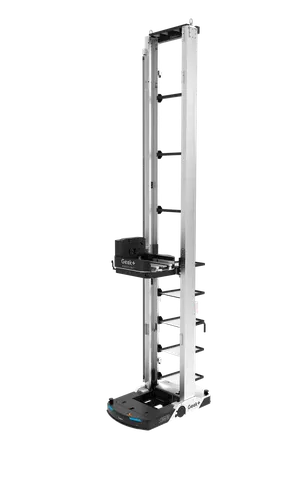
| Tote and case handling robot | Individual totes or cartons picked from shelving, often several per trip | Geek+ RS8-DA, Geek+ RS11-DA, Quicktron M5E | RS8-DA lifts to 7,935 mm and RS11-DA to 10,765 mm (Geek+ RS series); M5E rated load 50 kg (Quicktron M series) |
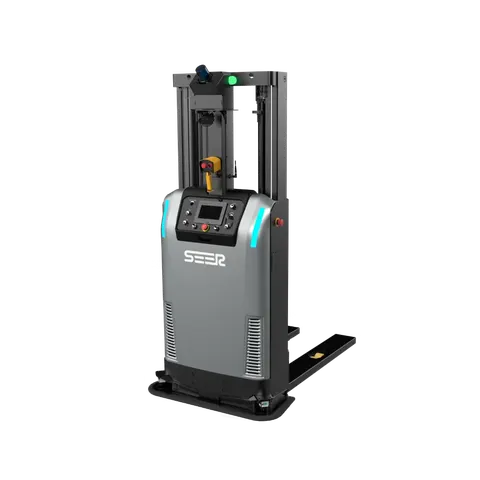
| Autonomous forklift, stacker or reach truck | Pallets between docks, floor locations and racking | SEER SFL-CDD14, VisionNav VNR 16, Mooe MEC1-1400 | SFL-CDD14 rated at 1,400 kg with a 600 mm load centre, lifting height 1,600 or 3,000 mm (SEER SFL-CDD14) |
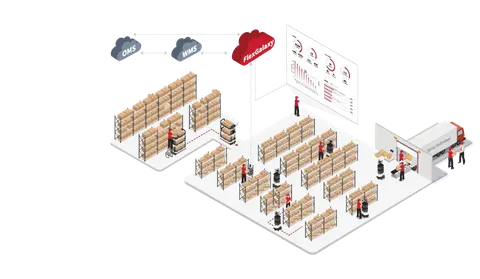
| Collaborative picking AMR | Totes or cartons that people pick into while the robot moves through the aisles | Syrius FlexSwift, Syrius FlexSwift Max | Request the payload, speed and battery data for your configuration |
| Open platform or chassis | Your own top module, conveyor or manipulator | SEER AMB-300, Youibot P500, Youibot OW-8 | Request the payload, interfaces and SDK documentation |
Two details from these documents are easy to miss. Geek+ gives the RS11-DA a no-load speed of 1.8 m/s and a full-load speed of 1.2 m/s. Any throughput estimate should use the loaded figure. SEER rates the SFL-CDD14 at 1,400 kg with a load centre of 600 mm. A pallet whose centre of gravity sits further out reduces what the truck can carry safely, so give the maker your pallet sizes and load distribution.
Navigation method and the building
Chinese logistics robots use three broad approaches, and makers often offer more than one.
Floor codes. The robot reads QR codes or other markers fixed to the floor, often combined with inertial sensors. Quicktron lists QR code navigation for its under-rack lifting models, and QR code plus inertial navigation for the M5E. Positioning is repeatable and independent of the surroundings, but the codes must be installed, kept clean and replaced when damaged, and the route grid is fixed by the layout.
Laser SLAM. The robot builds a map from LiDAR scans and localises against walls, racking and fixed objects. No floor markers are needed, and routes can change in software. Performance depends on stable features. Large open areas, reflective surfaces and layouts that change every day need testing.
Visual or hybrid methods combine cameras with LiDAR or codes. Ask exactly which sensors localise the robot in your environment and what the maker requires for them to work.
Whatever the method, read the maker's operating conditions. For example, Geek+ lists floor flatness of no more than 3 mm within 1 m² among the operating conditions of its P40R shelf robot (Geek+ RS and P series). Commission a floor survey against the figures for the robot you choose, and include joints, ramps, dock levellers and drainage channels.
For more on LiDAR types used on mobile robots, see solid-state vs mechanical LiDAR.
Fleet size and throughput
A robot's speed and payload set a ceiling, but the number of robots you need depends on travel distances, traffic at stations and lifts, charging and the pick rate of the people working with them. Ask each supplier to run a simulation with your order lines, SKU profile and layout. Then ask for the assumptions behind it: pick rate per station, average trip length, charging strategy and peak factor. Compare suppliers on the same assumptions, and agree the throughput acceptance test before the purchase order.
Charging affects fleet size directly. Ask for the battery capacity, charging time and runtime per charge in your duty cycle, and the number of chargers the proposal includes. For lithium battery transport, see shipping and customs documents for robots.
Software and integration
The fleet manager allocates tasks, plans routes and manages traffic and charging. Most projects also need an interface to the warehouse management system. Confirm:
- Whether the maker supplies the interface to your WMS or MES, the protocol it uses and who is responsible for each side.
- How doors, lifts, fire shutters and conveyors are integrated, and which hardware that requires.
- Whether robots from other makers can share the site, and through which interface.
- Where the fleet software runs (on site or in the cloud), what data leaves the site and how remote access for support is controlled.
- Software licence terms, update policy and the cost of adding robots later.
Safety and acceptance
Logistics robots share space with people and manual equipment. Ask for the safety functions of each robot: obstacle detection sensors and their fields, emergency stops, speed limits in shared zones and the behaviour at blind corners. For autonomous forklifts and other driverless industrial trucks, ask which standards the truck has been assessed against and for the certificate number and issuing body, so you can check them yourself. Agree who carries out the risk assessment of the finished installation.
Define acceptance in writing: throughput at peak, order accuracy, uptime over an agreed period and the response time for faults.
What a complete quotation includes
- Robots by type and quantity, with the configuration of each.
- Chargers, spare batteries and any floor codes, reflectors or markers.
- Fleet management software, WMS interface and licences, with renewal terms.
- Racks, totes or top modules if the system needs them.
- Site survey, mapping, commissioning, training and go-live support.
- Spare parts kit, warranty terms, response times and where service engineers are based.
- Incoterm, delivery schedule and the dangerous goods status of the batteries.
Checklist for a mobile robot inquiry
- Unit loads with dimensions and weights, and pallet load centre if relevant.
- Layout drawing with aisles, doors, lifts, ramps and storage heights.
- Order and move volumes at average and peak, and operating hours.
- Floor survey results and environmental conditions.
- Preferred navigation method and any restrictions on floor markers.
- WMS or MES details and the integration boundary.
- Safety requirements for shared zones and the documents you need for your market.
- Requested quotation scope as listed above, delivery date and acceptance tests.
Sources
FAQ
Should I choose QR code navigation or laser SLAM?
QR code navigation gives repeatable positioning on a fixed grid but needs markers on the floor. Laser SLAM avoids markers and allows route changes in software but depends on stable surroundings. Test the method in your building with the maker's survey.
Can I mix robots from different makers?
It depends on the fleet software and interfaces each maker supports. Ask both makers before you plan a mixed fleet, and agree who resolves traffic conflicts.
How many robots do I need?
Ask for a simulation using your own order data, and check its assumptions on pick rate, travel distance and charging. Top speed alone does not determine fleet size.
What does the floor need?
Each maker states its floor conditions, such as flatness, gaps and slopes. Survey the floor against the figures for the robot you choose before ordering.
Planning a robotics purchase? Share the quantity, configuration and destination so we can check fit, availability and quote requirements.
Request a quote— The Sourcebotics sourcing desk
Related products
- Payload
- 100 kg
- Max Speed
- 2 m/s
- Type
- Collaborative picking AMR