Collaborative Robots from China: How to Choose Payload, Reach and Safety Functions
Source: https://sourcebotics.com/guides/collaborative-robots-buyers-guide/
Short answerSize a cobot from the full load at the wrist and the reach the task really needs, then compare models from different makers at the same payload class. Treat collaborative operation as a property of the finished application, not of the arm alone. Before ordering, get the safety functions, communication options, controller scope and software licences in writing.
Start with the task, not the arm
Most cobot selection mistakes come from sizing the arm against the part alone. The payload the arm must carry is the part plus the gripper, any tool changer, the camera or sensor on the wrist, the cable dress pack and the adapter plate. The centre of gravity of that combined load usually sits some distance from the flange. Most manufacturers publish a payload diagram that reduces the permitted load as that offset grows.
Write down five things before you request quotations:
- Total wrist load and its centre-of-gravity offset from the flange.
- Reach: the farthest and nearest points the tool must reach, including approach and retreat moves, not only the pick and place points.
- Cycle time and how many cycles per shift the cell must deliver.
- Mounting: floor, table, wall, ceiling or a mobile base, and the space around the robot.
- People: who works next to the robot, how often they enter its working space and what they do there.
With these figures you can shortlist a payload class and check every offer against the same requirement.
Payload and reach across Chinese cobot ranges
The models below are listed on Sourcebotics with payload and reach taken from the manufacturer documents linked in the last column. Each figure is the maker's own catalog value; reach is the maker's stated working radius.
| Model | Payload | Reach | Manufacturer document |
|---|---|---|---|
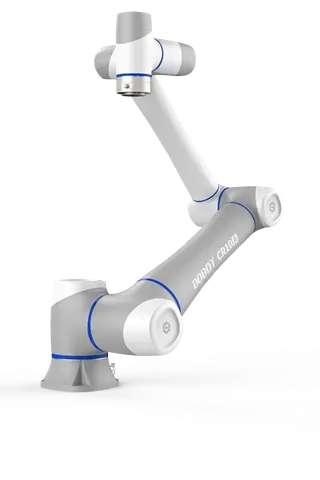
| DOBOT CR3A | 3 kg | 620 mm | DOBOT CRA series |
| DOBOT CR5A | 5 kg | 900 mm | DOBOT CRA series |
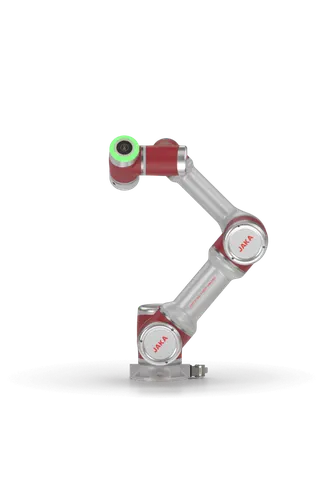
| JAKA Zu 5 | 5 kg | 954 mm | JAKA Zu 5 |
| JAKA Zu 7 | 7 kg | 819 mm | JAKA Zu 7 |
| DOBOT CR7A | 7 kg | 800 mm | DOBOT CRA series |
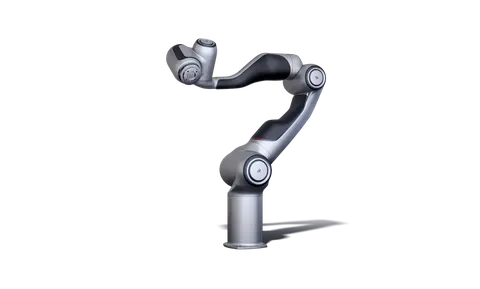
| Agile Robots Diana 7 | 7 kg | 923 mm | Diana 7 product flyer |
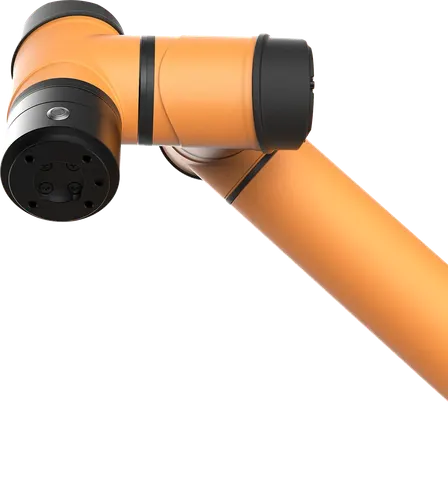
| AUBO-i10 | 10 kg | 1,350 mm | AUBO catalog |
| DOBOT CR10A | 10 kg | 1,300 mm | DOBOT CRA series |
| DOBOT CR12A | 12 kg | 1,200 mm | DOBOT CRA series |
| AUBO-i16 | 16 kg | 967.5 mm | AUBO catalog |
| JAKA Zu 18 | 18 kg | 1,073 mm | JAKA Zu 18 |
| AUBO-i20 | 20 kg | 1,650 mm | AUBO catalog |
| DOBOT CR20A | 20 kg | 1,700 mm | DOBOT CRA series |
| DOBOT CR30A | 30 kg | 1,305 mm | DOBOT CRA series |
Two patterns stand out. First, payload and reach do not rise together. The AUBO-i10 reaches 1,350 mm with 10 kg, while the AUBO-i16 carries 16 kg over 967.5 mm. Within the DOBOT range, the CR20A reaches farther than the CR30A. Pick the reach your layout needs, then the payload, and accept that the heaviest arm is not always the longest.
Second, models in the same payload class differ in reach by more than 100 mm. At 7 kg, the Diana 7 lists 923 mm and the DOBOT CR7A 800 mm. That difference can decide whether a single arm serves two machines or only one.
For filters by payload, reach and other listed specifications, see the collaborative robot comparison.
Read payload, reach and repeatability correctly
Payload is the maximum load at the flange under the conditions the maker defines. Check the payload diagram for your centre-of-gravity offset, and ask whether full speed is allowed at full payload or whether the controller limits speed and acceleration.
Reach is normally the radius from the base axis to the wrist centre or to the flange. Makers do not all measure to the same point, and the usable reach for a tool pointing down is shorter than the maximum radius. Lay the robot's working envelope drawing over your cell layout before you commit.
Repeatability describes how closely the arm returns to a taught point, for example ±0.02 mm for the JAKA Zu 5 on its product page. It is not absolute accuracy. If your program uses positions calculated from CAD or from a vision system rather than taught points, ask for the absolute accuracy and how it is calibrated.
Collaborative operation belongs to the application
A cobot's built-in functions, such as collision detection, speed and force limits and safety-rated inputs, make collaborative applications possible. They do not make every application safe. A sharp tool, a heavy part or a fast move can still injure someone even when the arm stops on contact. The risk assessment has to cover the whole cell: arm, end-effector, workpiece, fixtures and the way people work around it. Agree in writing who carries out and documents that assessment before the cell is installed.
Ask each supplier for the list of safety functions, how they are configured and protected by password, the safety inputs and outputs on the controller and the stop categories used. Also ask for the safety standards the arm and controller have been assessed against, including the certificate number and issuing body for each, so you can check them directly. The ISO 10218 series covers industrial robot safety; confirm which parts and editions the documents refer to.
Force sensing, software and integration
Collision detection in many cobots is based on motor current. Force-controlled models add joint torque sensing or a wrist force/torque sensor for tasks such as polishing, insertion and hand guiding. If force control matters, ask how force is measured, at what rate and with what resolution, and test it on your task with a sample. For background on wrist sensors, see six-axis force/torque sensors explained.
Software decides how fast you can deploy. Check:
- Programming: graphical blocks, scripting, hand-guided teaching and offline programming.
- Interfaces to your line: digital I/O, Modbus TCP, PROFINET, EtherNet/IP or others. Note which are standard, which are optional modules and which need a licence.
- Developer access: SDK languages, ROS or ROS 2 drivers and the controller firmware versions they support.
- End-effector integration: tool flange standard, tool I/O, power at the wrist and available plug-ins for grippers and cameras.
Controller, power and installation
Confirm what the controller is and what it needs. Some cobots use a separate control box, others integrate the electronics. Check the supply voltage, whether a DC version exists for mobile bases, the IP rating of the arm and controller, permitted mounting orientations, ambient temperature and the length of the arm cable. If the robot will sit on a mobile platform, ask for the power draw at rest and in motion.
What a complete quotation includes
A cobot price can mean very different scopes. Ask every supplier to itemise:
- Arm, controller, teach pendant or tablet, cables and the base or mounting plate.
- Software licences and any optional modules, with renewal terms.
- Communication modules for your PLC or fieldbus.
- Documentation: user manual, safety manual, electrical drawings, 3D model and the declaration of conformity for your market.
- Training, commissioning support and remote support hours.
- Warranty period and what it covers, spare parts list, repair turnaround and where repairs are done.
- Packing, Incoterm, delivery date and the battery or dangerous goods status of any accessories.
Checklist for a cobot inquiry
- Total wrist load, centre-of-gravity offset and the required payload diagram.
- Reach envelope with tool orientation, and the cell layout drawing.
- Cycle time target and the moves in one cycle.
- Mounting and environment: orientation, IP rating, temperature, cleanliness.
- Safety functions, safety I/O and the certificates you need for your market.
- Programming method, line interfaces and developer access.
- Force sensing requirement, if any, and how you will test it.
- Full quotation scope as listed above, quantity and delivery date.
Send the same list to every supplier so the answers can be compared line by line.
Sources
FAQ
Is a cobot safe to use without guarding?
Not automatically. Whether guarding can be reduced depends on the risk assessment of the complete application, including the tool, the part and how people work near the robot.
How much payload margin should I leave?
Use the maker's payload diagram for your actual centre-of-gravity offset rather than a fixed percentage. Leave room for later changes to the gripper or the part.
Do Chinese cobots work with Western grippers and cameras?
Many grippers and cameras connect through the tool flange, tool I/O and the controller's communication options. Confirm that the flange pattern, connector, voltage and software plug-in match the devices you plan to use.
Can I evaluate one arm before a volume order?
Yes. Agree the test task, success criteria and the configuration you will order later, so the sample represents production units. See how to evaluate robot component samples.
Planning a robotics purchase? Share the quantity, configuration and destination so we can check fit, availability and quote requirements.
Request a quote— The Sourcebotics sourcing desk