Absolute vs Incremental Encoders: How Robot Joints Know Where They Are
Source: https://sourcebotics.com/guides/absolute-vs-incremental-encoders/
Short answerAn incremental encoder counts movement from a reference point and loses its position when power is removed; an absolute encoder reports a unique position at all times. Robot joints increasingly use absolute encoders, often on both the motor and the output side, so they can start without homing. Choose by start-up behaviour, resolution, interface, and whether you need multi-turn position.
What an encoder measures
An encoder converts rotation into a signal the controller can read. In a robot joint it usually serves two purposes: commutation of the motor, which needs the rotor's electrical angle, and position control of the joint, which needs the output angle. A single encoder on the motor shaft can do both if the gearbox ratio is known and the joint never slips. Many joint modules add a second encoder on the output to measure the joint angle directly, which removes the effect of backlash and lets the controller detect a mismatch between motor and output.
Incremental encoders
An incremental encoder produces pulses as the shaft turns, usually on two channels, A and B, offset by a quarter period. The controller counts the edges and reads the direction from their order. A third channel, the index or Z pulse, marks one point per revolution. After power-up the controller knows only that the shaft has not moved since it started counting, so the machine must perform a homing move to a switch or the index pulse before it knows its absolute position.
Incremental encoders are simple, fast and inexpensive, and the A/B/Z interface is supported by almost every motion controller. They remain common on conveyors, wheels and machines where homing at start-up is acceptable.
Absolute encoders
An absolute encoder reads a coded pattern, or measures a magnetic or inductive field, so that each shaft position produces a unique value. The position is known as soon as the encoder is powered. A single-turn absolute encoder reports the position within one revolution; a multi-turn encoder also counts complete revolutions, which a motor-side encoder needs if the joint must know its output angle through a gearbox.
Multi-turn counting is done in one of three ways: a battery that keeps the counter alive when main power is off, a mechanical gear train that drives additional code discs, or an energy-harvesting Wiegand sensor that registers each turn without a battery. Battery-backed systems need the battery replaced or charged; if it runs flat, the joint must be re-referenced.
| Property | Incremental | Single-turn absolute | Multi-turn absolute |
|---|---|---|---|
| Position after power-up | Unknown until homing | Known within one turn | Known across many turns |
| Typical interface | A/B/Z pulses | Serial digital | Serial digital |
| Homing needed | Yes | Only if turns matter | No |
| Complexity and cost | Low | Moderate | Higher |
| Typical robot use | Wheels, conveyors | Output-side joint encoders | Motor-side encoders through a gearbox |
Sensing technologies
Optical encoders shine light through or onto a patterned disc and read it with photodetectors. They achieve high resolution and accuracy, but they are sensitive to contamination and need careful assembly.
Magnetic encoders read a magnet on the shaft or a magnetised ring with Hall-effect or magnetoresistive sensors. They tolerate dust and vibration and are compact, which is why they are common in integrated joint modules. Their accuracy depends on the magnet, the mounting and calibration.
Inductive and capacitive encoders measure changes in a field between a rotor and a stator printed on circuit boards. They are robust and can be very thin, which suits hollow-shaft joints.
Resolution, accuracy and interfaces
Resolution is usually stated in bits per revolution: a 17-bit encoder divides one turn into 131,072 steps, and a 21-bit encoder into 2,097,152 steps. Resolution is not accuracy. Accuracy, stated in arcseconds or arcminutes, describes how close the reported position is to the true position and depends on the disc, the mounting and the electronics.
Absolute encoders communicate over serial protocols. Common examples include SSI, BiSS-C, EnDat and several manufacturer-specific protocols used by servo drives. The drive or controller must support the exact protocol and its configuration, such as data length and clock rate, so confirm compatibility before choosing an encoder.
Where each type goes in a robot joint
Integrated joint modules typically place a magnetic or optical encoder on the motor for commutation and fast control, and an absolute encoder on the output to report the joint angle directly. This dual-encoder arrangement allows the joint to start in a known position, compensates for gearbox backlash and elasticity, and gives a safety check if the two readings disagree. Wheels and conveyors often use incremental encoders because homing is not needed or is easy.
Checklist when selecting an encoder
- Must the axis know its position at power-up without moving?
- Is the encoder on the motor side or the output side, and does it need multi-turn counting?
- What resolution and accuracy does your control loop need at the output?
- Which protocol does your drive or controller support?
- What shaft or hollow-bore size, mounting space and cable exit are available?
- What contamination, vibration and temperature will it see?
Sources
FAQ
Is a higher bit count always better?
Not by itself. Beyond the resolution your control loop can use, extra bits add little, while accuracy and noise matter more. Compare accuracy figures and test the encoder in your mechanical set-up.
What happens if a battery-backed multi-turn encoder loses power?
The turn count is lost and the joint must be re-referenced. Check the battery life and the replacement procedure, or choose a battery-free design.
Can I replace an incremental encoder with an absolute one?
Usually only if the drive supports the absolute encoder's protocol. Check drive compatibility first.
Planning a robotics purchase? Share the quantity, configuration and destination so we can check fit, availability and quote requirements.
Request a quote— The Sourcebotics sourcing desk
Related products
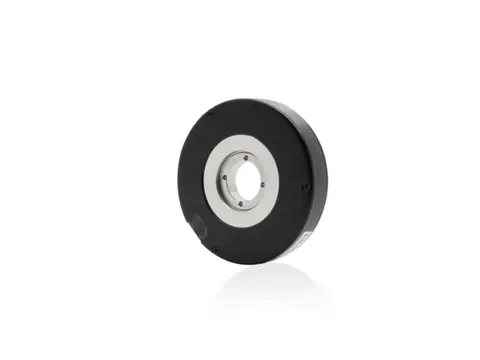
- Type
- Absolute optical rotary encoder, hollow shaft
- Outer Diameter
- φ85 mm
- Thickness
- 16 mm
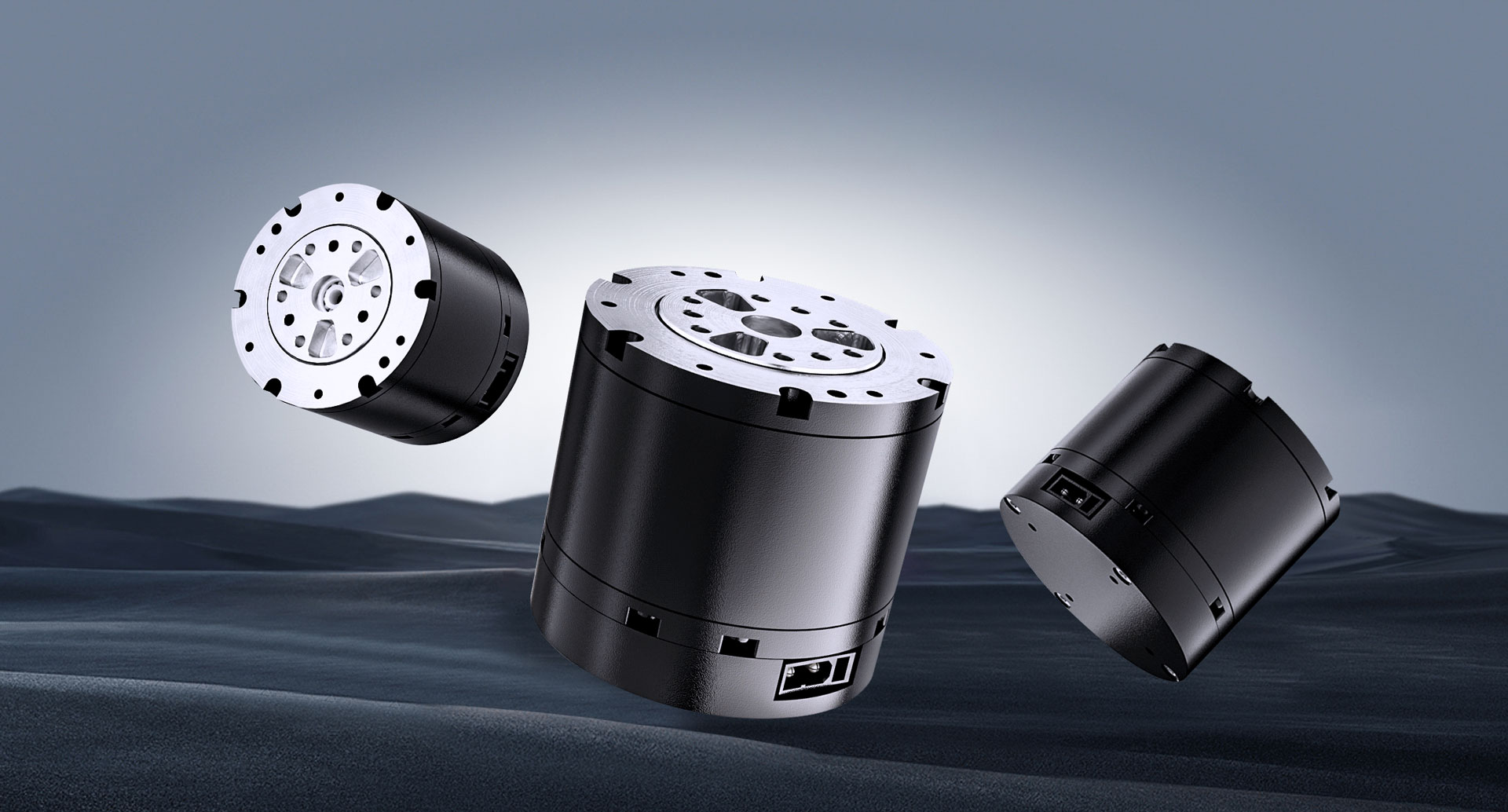
- Peak Torque
- 14 N·m; short-duration load
- Nominal supply
- 48 VDC
- Encoder arrangement
- 2 magnetic encoders; 14-bit single-turn absolute resolution
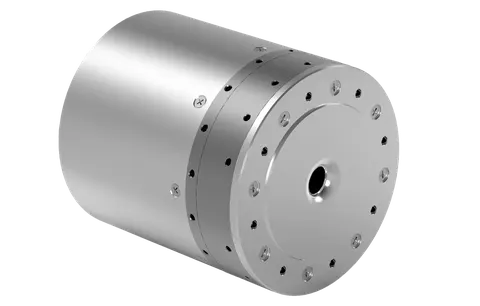
- Rated Torque
- 120 N.m
- Rated Speed
- 30 rpm
- Reduction Ratio
- 100:1